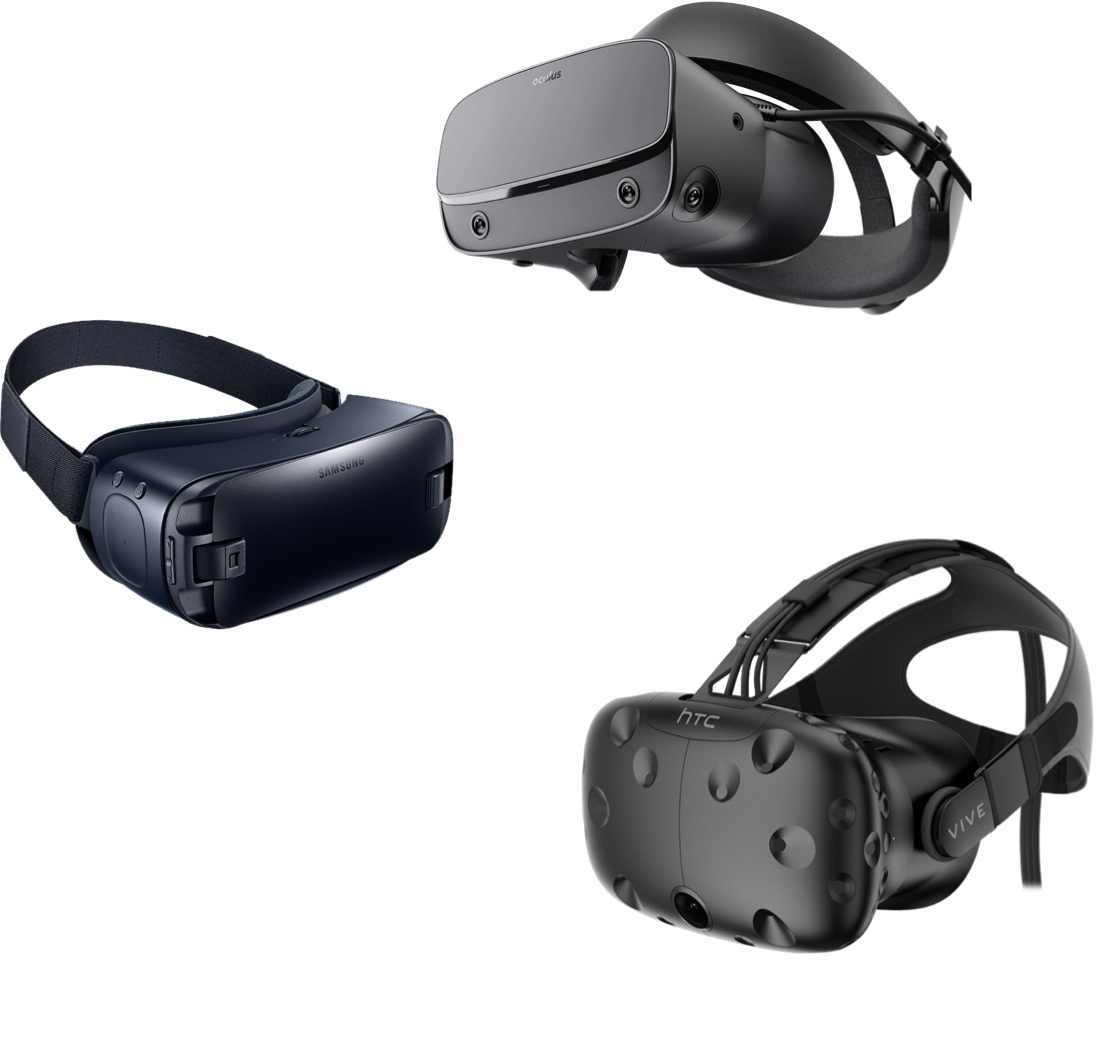
The project is to develop a VR Poker Application that proves a synchronous multiplayer experience across several VR platforms and input types. In the game, one player can use Oculus Rift and Xbox controller to gamble against another player who uses HTC Vive. A spectator can use Samsung Gear VT to observe the gameplay. Players are represented as dogs in a saloon.
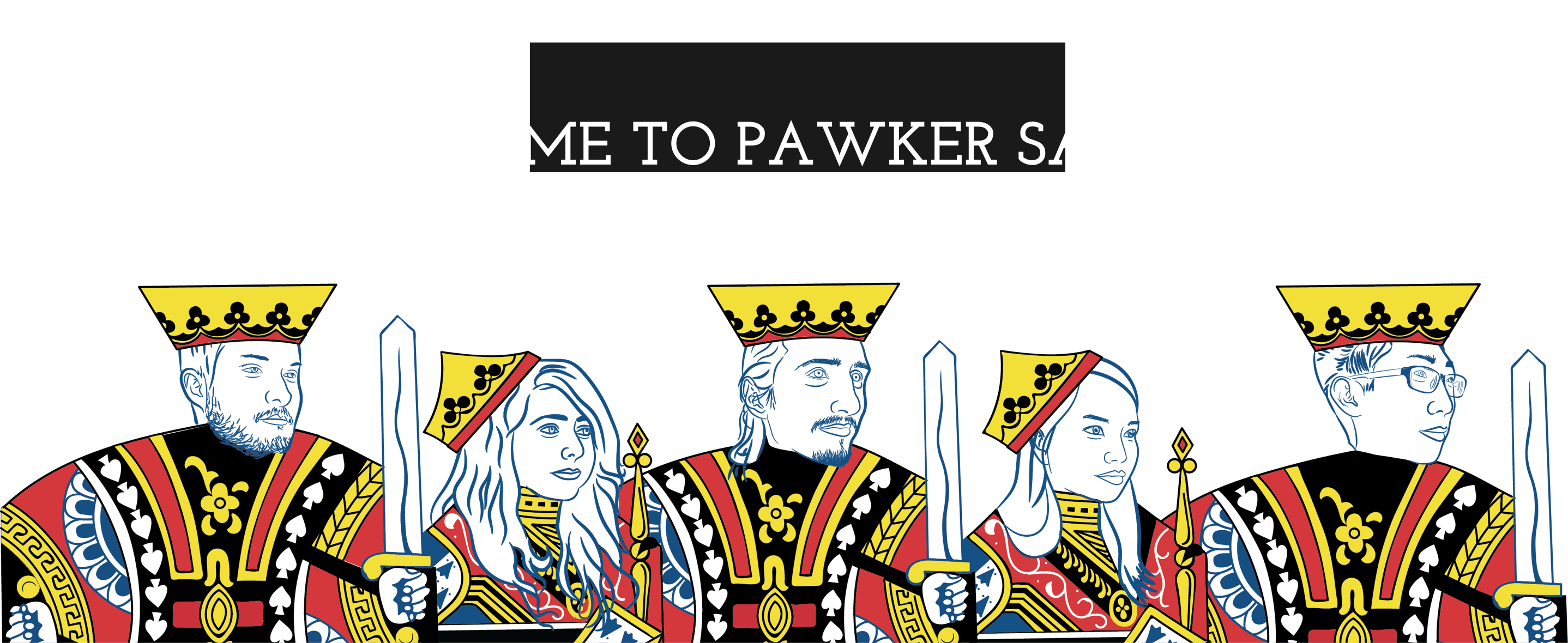
The project was completed through the collaboration between Roadhouse Interactive and Center for Digital Media. I was working as a UI/UX Designer & 3D Artist in a team of 5.
1. The first challenge we faced is how to blur the edges between different VR platforms and control schemes to deliver a seamless user experience.
2. The second difficulty is how to find a friendly medium that helps translate the traditional face-to-face poker-playing into a fun and engaging virtual space; also, differentiate the prototype from either a real-world experience such as casino, or other digital poker games.
3. The third question is how to appropriately utilize UI elements in VR environment for users to intuitively interatct with, and guide them to play poker asnaturally as before.
1. Technology: about VR, there are no formulas and rules of thumb, so we did extensive research into what leaders in the industry are investigating.
2. Context: None of us in the team was a ‘professional’ poker player. As we decided to use the rules of Texas Poker as the MVP, we learned the gameplay and also watched the championship of Poker to familiarize ourselves with the game.
3. Market: We also found a couple gambling projects, but none of them are very developed. Thus our research was conducted mostly by viewing and playing as many demos with the Gear, Vive and Oculus as we could.
4. User: The user research was to understand whom we were developing this game for, including what features these people would prioritize. Any features prioritized by multiple personas took higher priority than those weren’t prioritized by both. In the end, we summarized 4 types of users: Hard-core poker player, VR developer, VR green-hand, and VR expert users. Among these 4, we could merge them to have 2 major personas:
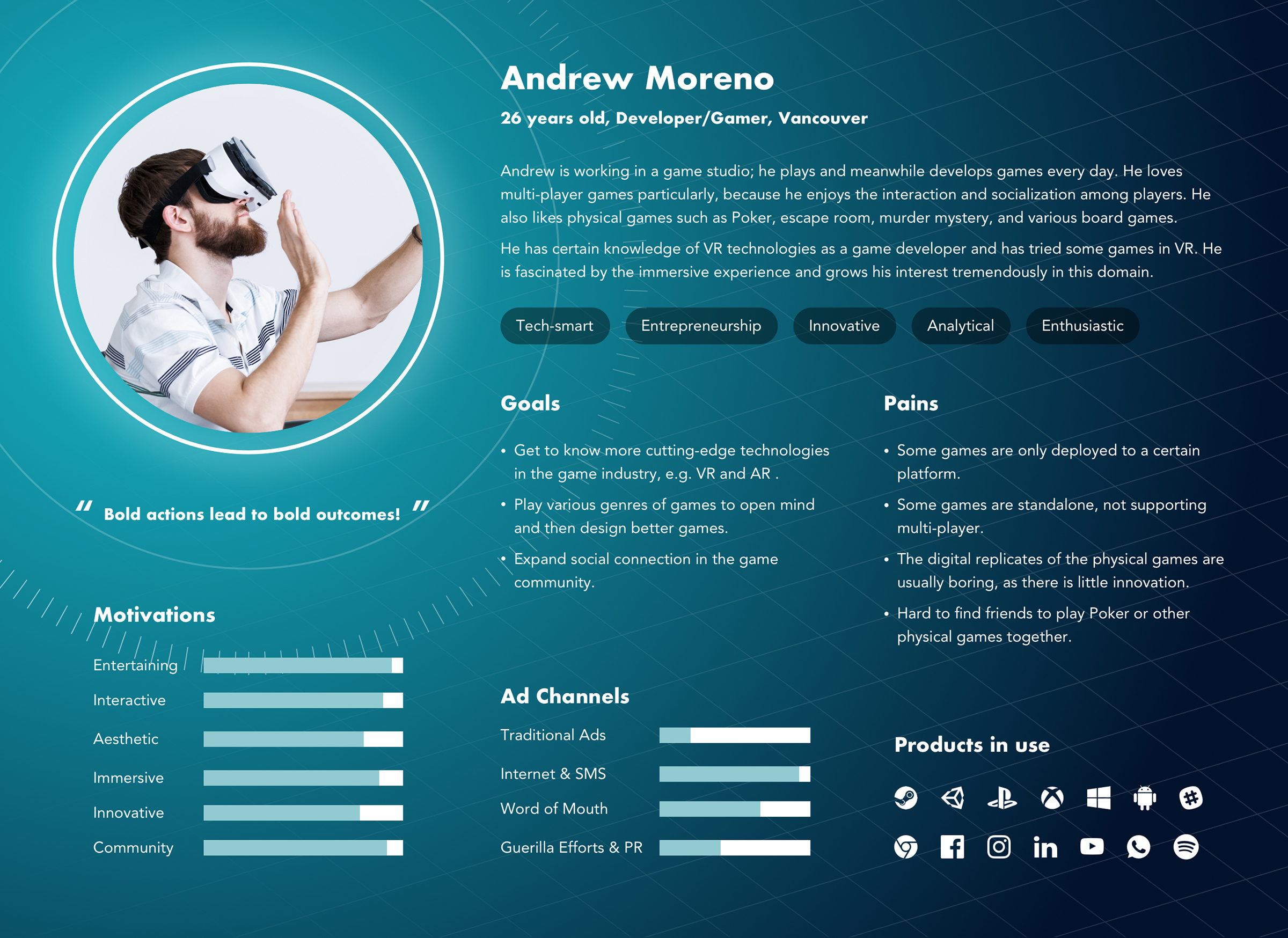
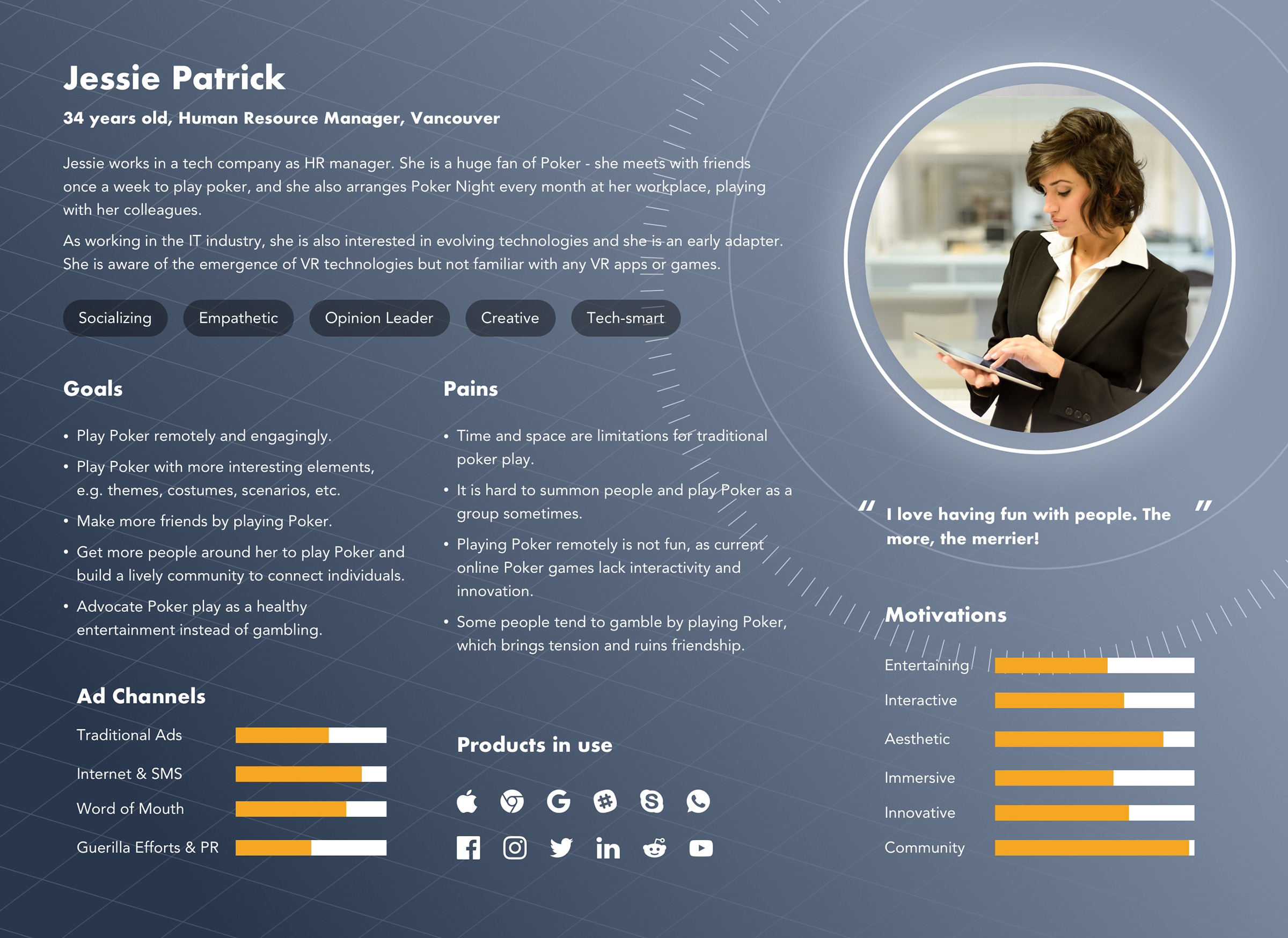
1. User Stories: According to the personas, we created and prioritized the user stories to depict what users want to achieve. We worked closely with the client to develop deliverables derived from user stories. For example, if a user story says ‘As a user, I want to use the HTC Vive controllers to interact with objects’, we would make a deliverable reflecting it as: HTC Vive controller compatibility with in-game objects.
We used user stories heavily to influence our deliverable list. Each user story explained a bit of how, why or what we were doing to make our game, from asset development to UX gameplay mechanics.
2. User flows: We created separate user flows for each case first, such as check, call, raise, and fold. Then, we incorporated them all to generate a complete flow with branches leading to different situations.
Since iterating on VR devices is time-consuming, it is efficient to craft paper prototypes to keep pace with the frequent user tests. Besides, with the limited access to VR equipment, designers could still test ideas by using physical substitutues, and meanwhile developers could keep the hardware to work. Plus, virtual reality lent itself well to physical prototpying, since experiences in the physical worls heavily influence the tactile experience of playing in a simulated environment.
To simulate the gaming experience to the largest degree, we made the paper props as close as possible to the real devices, such as the headset and controllers; meanwhile, we made props to reflect the UI ideas sketched previously, such as the dome buttons, the dog paw, etc, which also saved our efforts on 3d modelling before the UI was solidified.
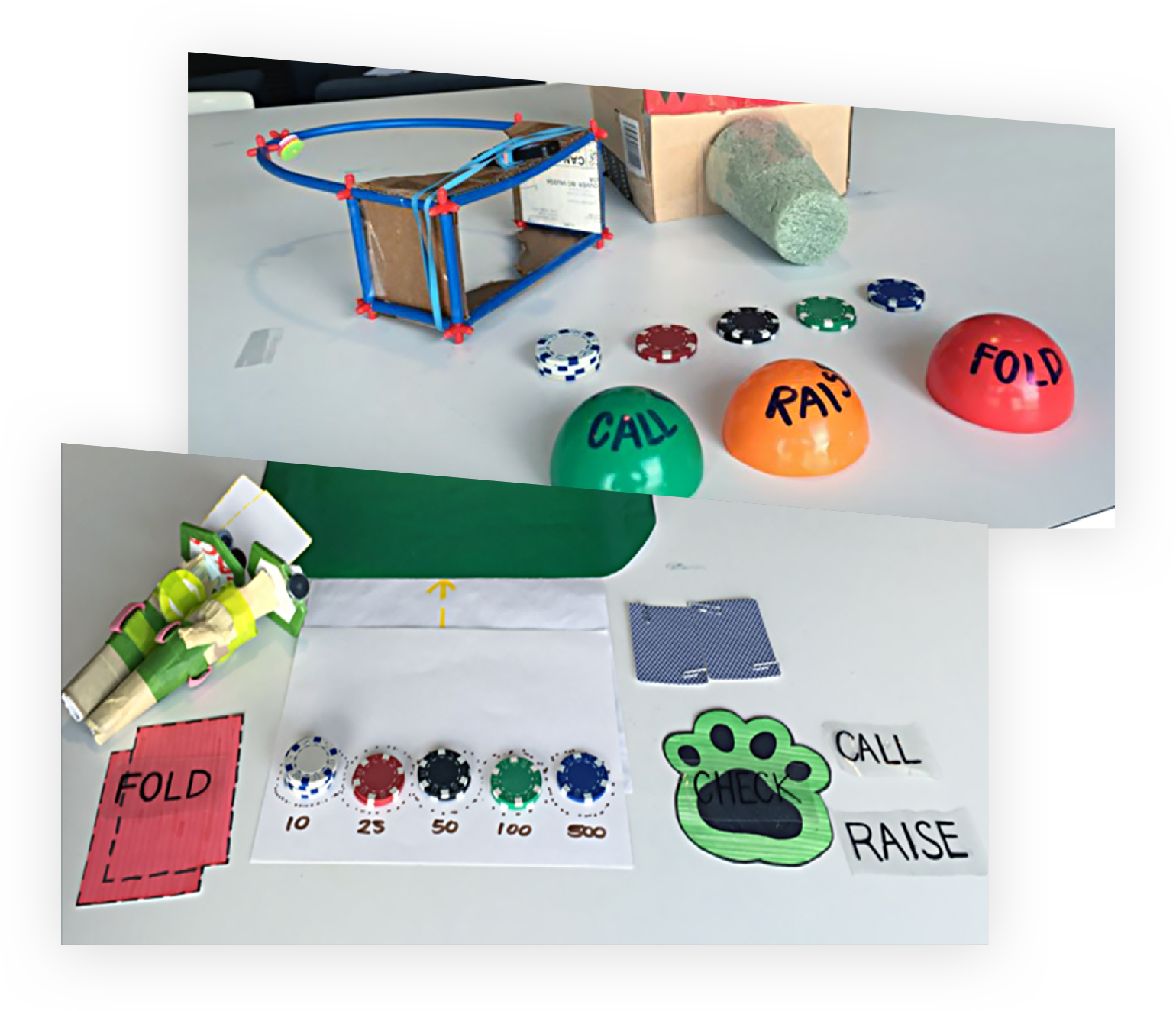
Iteration continued throughout the design process. Once the project picked up steam, the team would test a few aspects of the game each week to gain feedback. This allowed us to continuously evaluate the status of the project. In the test, we usually had a dealer to play as the computer AI, an observer who kept a close eye on the users’ actions and took notes, and a photographer to take shots and videos for the review’s purpose.
We conducted many user tests with all user types defined earlier, who all enjoyed the experiences we provided them with both physical and digital prototype variants. Experienced VR users were more concerned with the UX and wanted some form of tutorial. Poker players were curious about VR capabilities and wanted to engage with the environment when waiting for the other player to finish their turn - sipping beer for example.
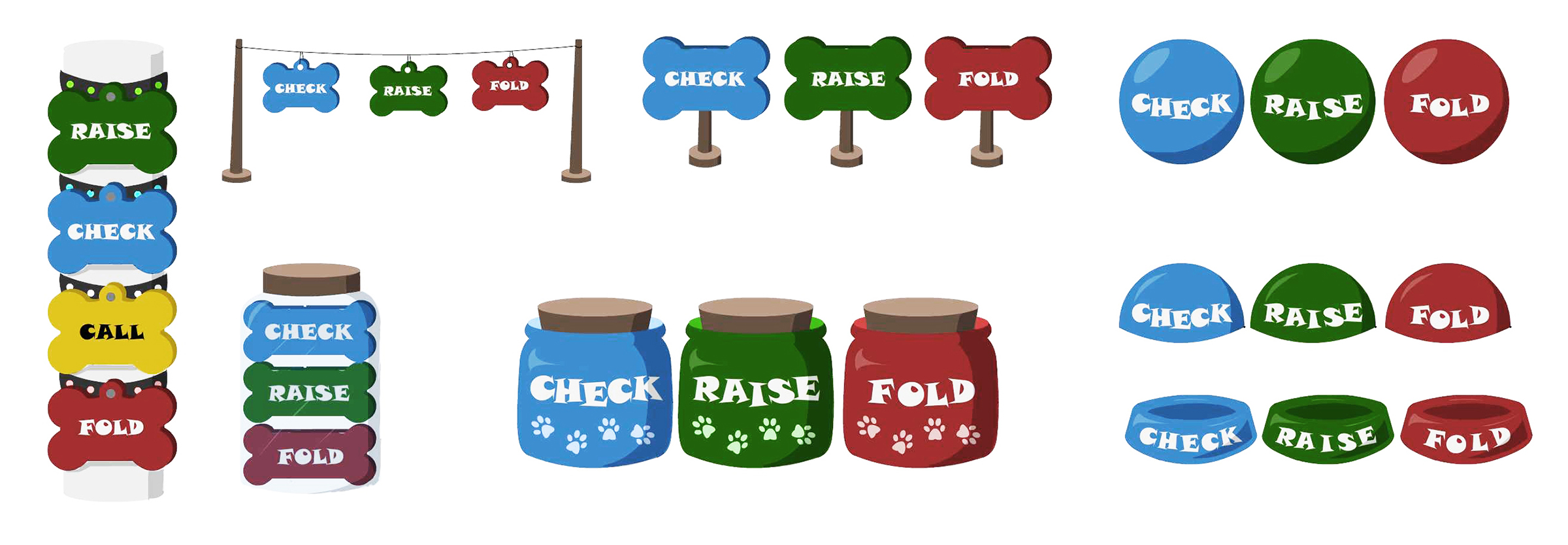
Unlike traditional poker play using voice and gesture, or online poker games using buttons and slider, interface design for VR poker is much trickier. It has to be intuitive, informative and visually comfortable in virtual space. Besides, it also needs to combine dog-specials to fit the theme. We explored by sketching, 3D modelling, and paper prototyping. We went through versions of squeaky toys, domes, doggy items, and dog paws. Eventually, the UI struck the balance between usability, simplicity, and appearance after times of iterations.
In order to provide a unique experience which users cannot access in their real life, we chose ‘dog-play-poker’, a widely-known cultural reference. Accordingly, the environment settings need to reflect the theme. Throughout the project, it also underwent multiple changes from the initial concept sketch -> dog pool -> dog room -> dog saloon in the end.
The video below is a single-player demo. I made this digital prototype by Unity according to the design, aiming to explore the most appropriate Ui, visual/sound feedback, the interaction with objects, and the poker-play logics. It helped visualize and clarify the designers’ ideas, provided a clearer reference for developers and facilitated the communications in the team. ALso, it helps us explore the aesthetics and styles.
Finally, we developed the multi-player digital prototype and implemented it to 3 platforms. The first video below is a trailer, showing the low-fi prototype on HTC Vive. The second video is a montage of users’ reactions while playing our prototype.